Contents
Why Integrate CRM with ERP?
As businesses grow, managing customer relationships, sales pipelines, service delivery and financial processes across disconnected systems becomes increasingly complex. Many organisations operate with separate CRM and ERP platforms, often supported by spreadsheets, manual processes and duplicated data.
Integrating your CRM with your ERP system brings these processes together, providing a single, connected view of your customers, operations and financial performance.
The Challenge of Disconnected Systems
Without integration, sales, finance, operations and customer service teams often work in silos. Customer information is duplicated across systems, processes become manual, and visibility across the customer lifecycle is limited.
This results in inefficiencies, delays in decision-making and a fragmented customer experience. As businesses scale, these challenges can restrict growth and increase operational risk.
Key Benefits of CRM and ERP Integration
- Single source of truth
All departments access the same real-time customer, sales and financial data, improving collaboration and consistency. - Improved quote and order management
Quotes created in CRM can seamlessly convert into sales orders within the ERP system, reducing manual effort and improving accuracy. - Enhanced visibility and forecasting
With consolidated data across CRM and ERP, businesses gain better insights into pipeline performance, customer activity and financial outcomes.
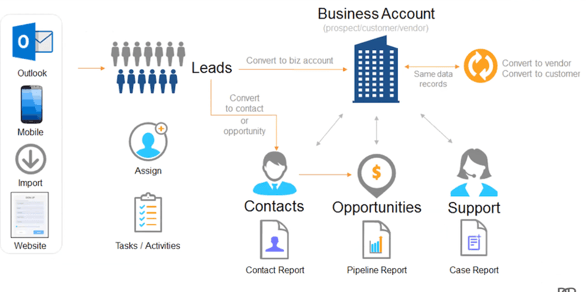
MYOB Acumatica CRM Overview
MYOB Acumatica includes built-in CRM functionality as part of its cloud ERP platform. Unlike standalone CRM systems, it provides a fully integrated environment where customer management, sales processes and financial operations are managed within a single system.
This means leads, opportunities, quotes, orders and customer transactions are all connected, providing a complete and real-time view of each customer.
Key Capabilities of MYOB Acumatica CRM
- Lead and opportunity management: Track prospects from initial enquiry through to conversion.
- Integrated sales and financials: Seamlessly move from quote to order to invoice within one system.
- Activity and communication tracking: Capture emails, calls and tasks in a single platform.
- Customer visibility: Access full customer history including sales, service and financial data.
- Reporting and dashboards: Gain insights into pipeline performance and customer trends.
This integrated approach reduces complexity and ensures all teams operate from a single source of truth.
Microsoft Dynamics 365 Sales Overview
Microsoft Dynamics 365 Sales is a dedicated CRM platform designed to manage customer relationships, sales pipelines and engagement activities. It offers advanced functionality for sales automation, forecasting and customer engagement.
When used alongside an ERP system, Dynamics 365 Sales requires integration to synchronise data between platforms. While this provides flexibility and depth in CRM capability, it also introduces additional complexity and ongoing integration management.
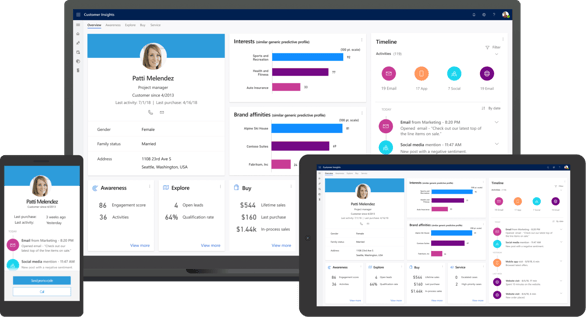
Key Capabilities of Microsoft Dynamics 365 Sales
- Advanced pipeline and opportunity management: Manage complex sales cycles with structured stages, forecasting and probability modelling.
- Sales automation: Automate lead qualification, follow-ups and workflow processes to improve efficiency.
- Customer insights and AI-driven recommendations: Leverage Microsoft’s AI capabilities for relationship insights and predictive forecasting.
- Integration with Microsoft ecosystem: Native integration with Outlook, Teams, Power Platform and Microsoft 365.
- Customisation and extensibility: Adapt the CRM platform to suit complex or industry-specific sales processes.
MYOB Acumatica vs Dynamics 365 Sales
- Platform approach: MYOB Acumatica provides an all-in-one ERP with built-in CRM, while Dynamics 365 Sales is a standalone CRM requiring integration.
- Implementation complexity: Integrated platforms are typically simpler to deploy and maintain, while separate systems require integration design and governance.
- Data consistency: A single system reduces duplication and synchronisation challenges.
- Flexibility: Dynamics 365 Sales offers deeper CRM capability, while MYOB Acumatica prioritises simplicity and unified operations.
Functional Capability vs Platform Strategy
When comparing MYOB Acumatica CRM and Microsoft Dynamics 365 Sales, many of the core CRM capabilities are functionally similar. Both platforms support lead and opportunity management, activity tracking, reporting and customer visibility.
The key difference is not necessarily capability, but how those capabilities are delivered:
- MYOB Acumatica: A unified platform where CRM and ERP are inherently connected.
- Dynamics 365 Sales: A best-of-breed CRM solution designed to integrate with ERP and other business systems.
This distinction has implications for implementation, user experience, data consistency and long-term system management.
Which Approach is Right for Your Business?
The right approach depends on your business priorities, operational complexity and growth plans.
- Integrated CRM + ERP (MYOB Acumatica): Ideal for organisations seeking simplicity, visibility and a unified platform.
- Best-of-breed CRM (Dynamics 365 Sales): Suitable for businesses with complex sales processes requiring advanced CRM functionality.
Next Steps: Review Your CRM and ERP Strategy
Ultimately, both approaches can deliver strong outcomes when implemented correctly. The decision comes down to your organisation’s structure, processes and long-term strategy.
Cloud Factory works with organisations to assess their current systems, define requirements and guide the selection of the right CRM and ERP approach.