
Manufacturing Pus
Microsoft Dynamics 365 Business Central
Extend Manufacturing Capability in Dynamics 365 Business Central
Manufacturing Plus enhances Business Central with advanced capabilities for engineering change control, tooling, by-product management, visualisation and analytics—improving compliance, traceability and production control.
The result is greater accuracy, reduced risk and more efficient, reliable manufacturing operations.
Address Key Manufacturing Challenges with Greater Control and Visibility
Engineering Change ControlChallenge: Managing engineering changes without clear visibility can lead to errors, compliance risks and production delays. Outcome: Maintain full audit trails and structured change processes that improve traceability, compliance and control. Tooling ManagementChallenge: Poor visibility of tooling availability and maintenance can result in unplanned downtime and inefficiencies. Outcome: Ensure tools are tracked, maintained and available when needed, reducing downtime and improving production reliability. Waste and By-Product ControlChallenge: Limited visibility of waste and by-products can lead to lost revenue and poor material utilisation. Outcome: Reduce waste, improve traceability and identify opportunities to recover value from by-products. |
Production Planning and Resource AllocationChallenge: Inefficient scheduling and limited visibility of production orders can create bottlenecks and delays. Outcome: Optimise resource allocation and gain clear visibility across production to improve throughput and efficiency. Proactive Issue IdentificationChallenge: Component shortages and capacity constraints are often identified too late, disrupting production. Outcome: Identify risks early, enabling proactive decision-making and minimising disruption to production schedules. Production Accuracy and Cost ControlChallenge: Inaccurate tracking of components, processes and costs impacts margins and decision-making. Outcome: Improve production accuracy and cost visibility through detailed manufacturing analysis and reporting. |
Business Impact
Organisations that implement structured Engineering Change Requests (ECRs) and Engineering Change Orders (ECOs) often see measurable operational and financial improvement. On this page, we take a deliberately conservative view by referring to up to 10% growth potential and 100% ROI, recognising that actual results depend on the maturity of existing processes, the volume of changes being managed and the complexity of the manufacturing environment.
The growth opportunity typically comes from improved operational capacity rather than direct sales activity. When engineering changes are managed in a controlled and visible way, manufacturers can reduce disruption on the shop floor, avoid production delays, improve scheduling accuracy and respond faster to change. This creates the ability to process more work, support more product variation and increase throughput without a proportional increase in overhead or management effort.
The return on investment is usually driven by reduced rework, fewer errors, lower waste, stronger traceability and better control over production changes. Businesses also benefit from faster approvals, improved compliance, clearer cost visibility and a reduced risk of outdated bills of materials, routings or component instructions being used in production. Even modest gains across these areas can quickly justify the investment, which is why a 100% ROI assumption is both credible and commercially responsible as a conservative benchmark.
In practical terms, ECR and ECO processes help manufacturers protect margin, improve production reliability and create a more scalable operating model. For businesses currently relying on manual processes, spreadsheets or informal approvals, the value can be especially significant.
Tool Tracking and Maintenance
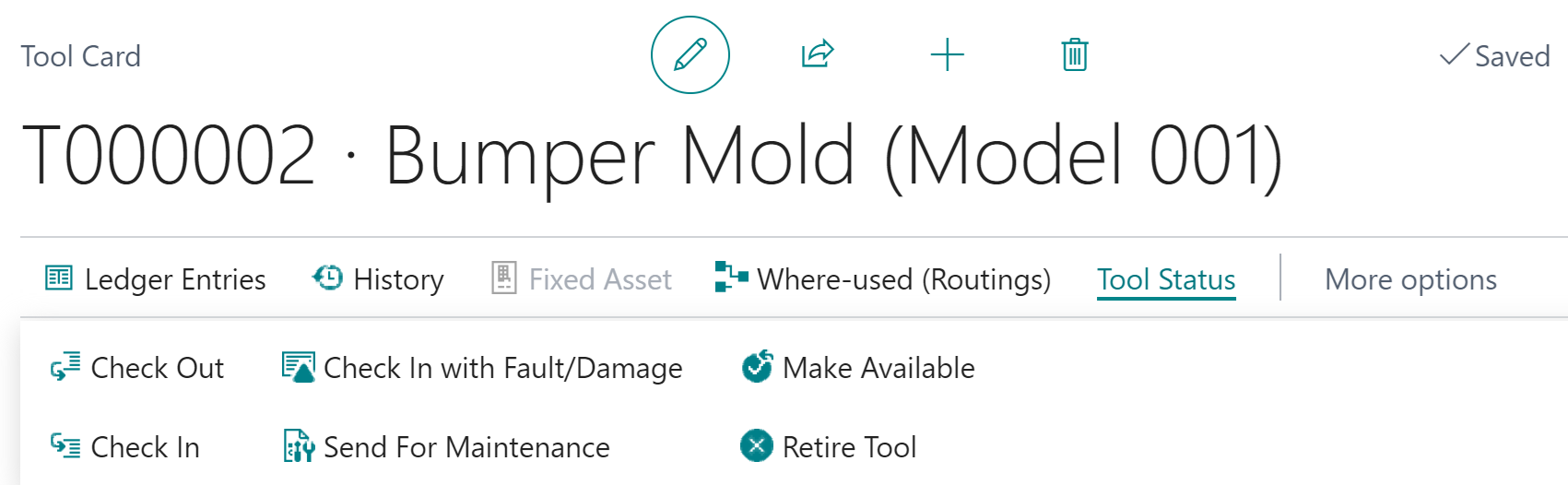
Effective tooling control is essential to maintaining reliable and efficient production. Tool Tracking and Maintenance provides a structured way to record, manage and monitor tools used across manufacturing operations, helping organisations improve availability, reduce downtime and maintain accurate usage history.
Detailed tool records can be created with descriptions, categories, maintenance intervals and key attributes, making it easier to identify the right tool for each routing operation. Tools can also be linked to fixed assets where required, giving manufacturers stronger visibility and control across the production environment.
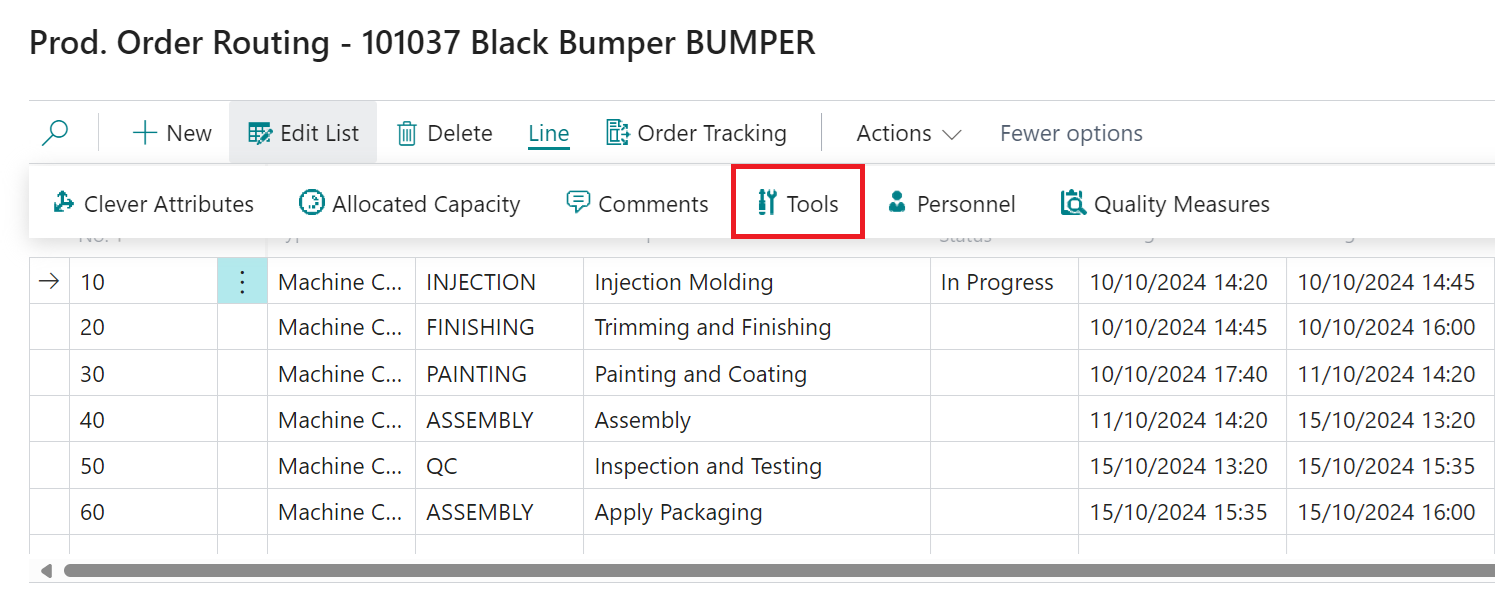
As tools are issued to production orders, usage can be tracked and maintenance scheduled based on actual utilisation rather than guesswork. This supports more precise servicing, reduces the risk of unexpected failures and helps ensure tools are available when needed. Integration with Clever MES also enables production teams to view required tools for routing operations and manage tool check-outs directly from the MES screen.
The result is better tool management, stronger production continuity and improved traceability. Manufacturers gain clearer visibility of tool location, maintenance history and tool usage by production order, making it easier to investigate issues, support quality control and maintain efficient operational workflows.
%
Growth
%
ROI
Business Impact
Organisations that implement structured Engineering Change Requests (ECRs) and Engineering Change Orders (ECOs) often see measurable operational and financial improvement. On this page, we take a deliberately conservative view by referring to up to 10% growth potential and 100% ROI, recognising that actual results depend on the maturity of existing processes, the volume of changes being managed and the complexity of the manufacturing environment.
The growth opportunity typically comes from improved operational capacity rather than direct sales activity. When engineering changes are managed in a controlled and visible way, manufacturers can reduce disruption on the shop floor, avoid production delays, improve scheduling accuracy and respond faster to change. This creates the ability to process more work, support more product variation and increase throughput without a proportional increase in overhead or management effort.
The return on investment is usually driven by reduced rework, fewer errors, lower waste, stronger traceability and better control over production changes. Businesses also benefit from faster approvals, improved compliance, clearer cost visibility and a reduced risk of outdated bills of materials, routings or component instructions being used in production. Even modest gains across these areas can quickly justify the investment, which is why a 100% ROI assumption is both credible and commercially responsible as a conservative benchmark.
In practical terms, ECR and ECO processes help manufacturers protect margin, improve production reliability and create a more scalable operating model. For businesses currently relying on manual processes, spreadsheets or informal approvals, the value can be especially significant.
Engineering Change Requests (ECRs)
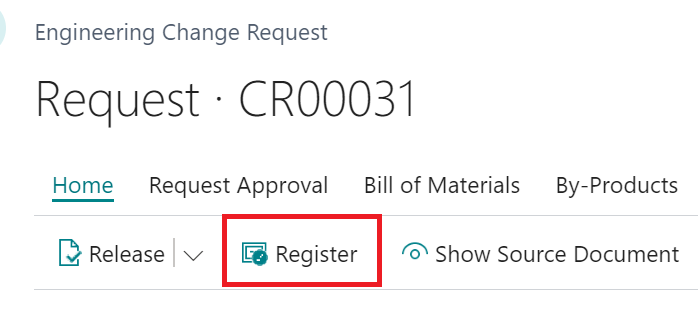
Engineering Change Requests (ECRs) provide a structured way to manage and control manufacturing changes with full visibility and traceability. Changes can be initiated from multiple sources including production orders, bills of materials, routings, by-products, items and stockkeeping units — ensuring issues such as part shortages or machine breakdowns are captured and addressed efficiently.
Users can quickly assess the cost impact of proposed changes and visually track modifications to bills of materials and routings. Additional notes can be recorded to support decision-making, while a formal approval process ensures all changes are reviewed and validated before implementation.
Engineering Change Orders (ECOs)
Engineering Change Orders (ECOs) are generated once an Engineering Change Request has been approved and actioned. ECOs apply the approved changes to the relevant master records while maintaining a permanent and auditable record of all modifications.
This structured approach enhances compliance, improves traceability and ensures manufacturing changes are implemented in a controlled and consistent manner. With a clear approval framework and complete audit trail, organisations can confidently manage ongoing production improvements while minimising risk.
By-Product Management
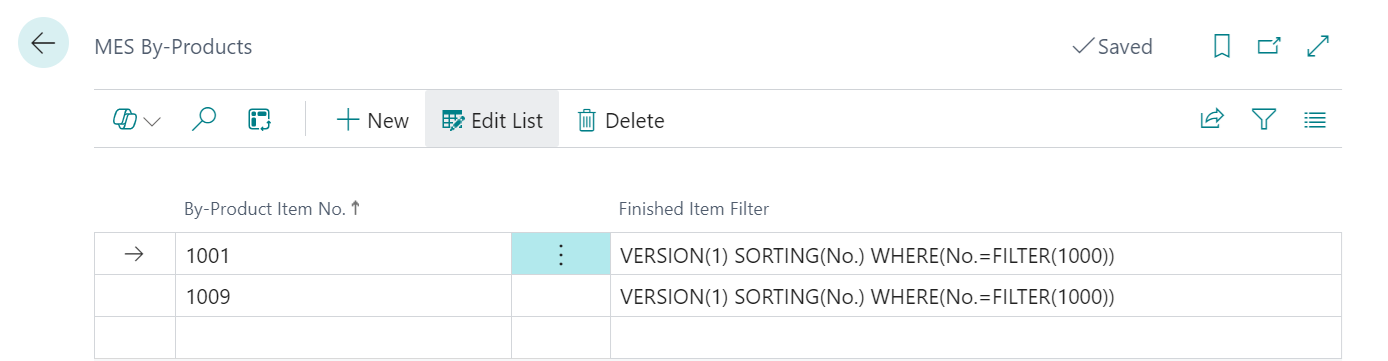
By-Product Management enables manufacturers to capture, control and utilise materials generated during production that would otherwise be treated as waste. This includes off-cuts, secondary outputs and items suitable for reuse, resale or disassembly processes.
By-products can be defined in a structured way, similar to a production bill of materials, and applied to items or stockkeeping units with full version control. This ensures consistency in how by-products are recognised and managed across different production scenarios.
During production, by-products are recorded directly against production orders as additional outputs, allowing manufacturers to track quantities, value and usage in real time. This provides greater visibility into material flows and supports more accurate inventory and costing processes.
The result is reduced waste, improved material utilisation and the potential to recover value from by-products that would otherwise be lost. Enhanced traceability also ensures that materials generated from production processes can be tracked, analysed and reused effectively, supporting both operational efficiency and sustainability objectives.
Manufacturing Extensions
Overview
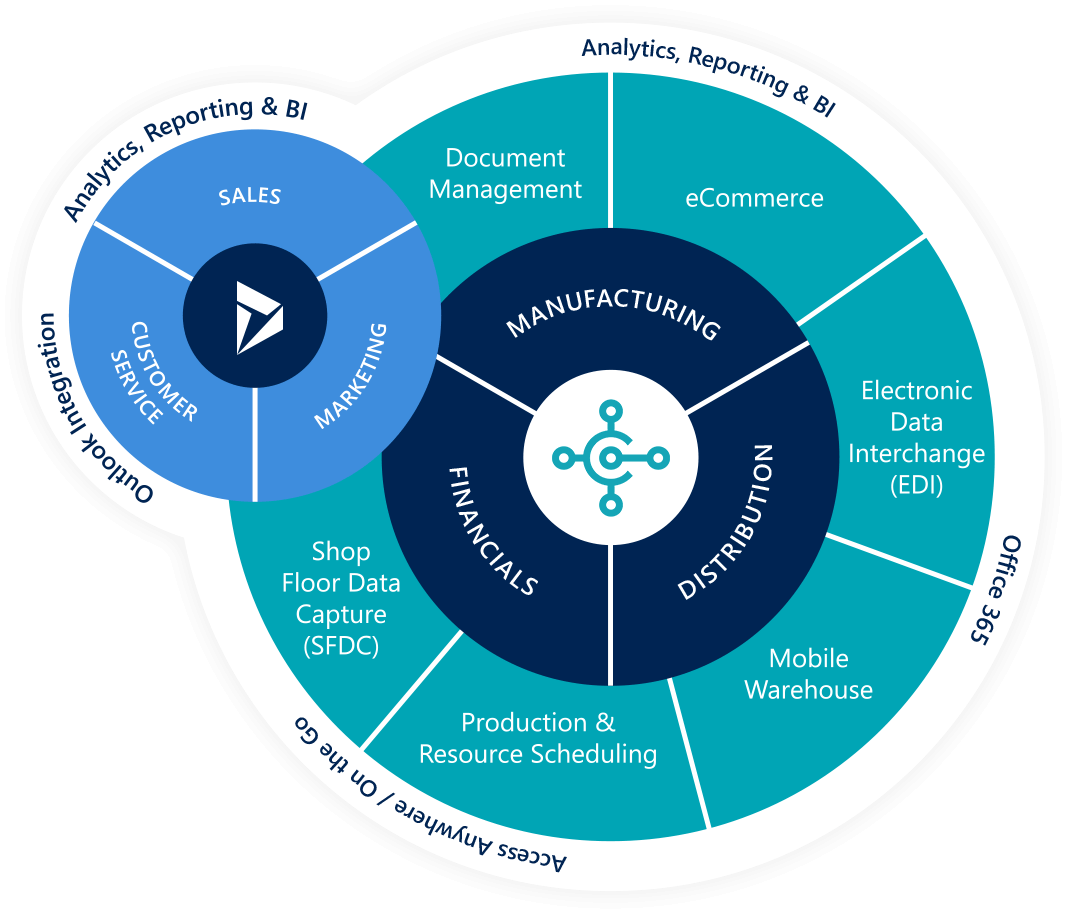
These manufacturing extensions enhance standard ERP capabilities, providing greater control, visibility and efficiency across production processes.
If you would like to see how these capabilities can be applied within your environment, we can include a tailored demonstration as part of your Manufacturing ERP Review.
By-Product Management
By-Product Management enables manufacturers to capture, control and utilise materials generated during production that would otherwise be treated as waste. This includes off-cuts, secondary outputs and items suitable for reuse, resale or disassembly processes.
By-products can be defined in a structured way, similar to a production bill of materials, and applied to items or stockkeeping units with full version control. This ensures consistency in how by-products are recognised and managed across different production scenarios.
During production, by-products are recorded directly against production orders as additional outputs, allowing manufacturers to track quantities, value and usage in real time. This provides greater visibility into material flows and supports more accurate inventory and costing processes.
The result is reduced waste, improved material utilisation and the potential to recover value from by-products that would otherwise be lost. Enhanced traceability also ensures that materials generated from production processes can be tracked, analysed and reused effectively, supporting both operational efficiency and sustainability objectives.
Enhanced Visualisation and Production Insight
Enhanced Visualisation Tools provide clear, intuitive views of manufacturing data, helping teams better understand and manage production processes. Visual representations of bills of materials and routing structures make it easier to interpret complex relationships and support more informed decision-making.
Production timelines display operations across each production order, allowing users to compare planned versus actual performance. When integrated with MES, this highlights delays, deviations and their impact on overall production schedules, enabling faster response and corrective action.
Load and capacity views provide real-time insight into machine and work centre utilisation, supporting more effective planning and resource allocation. By identifying constraints early, manufacturers can reduce bottlenecks, improve throughput and maintain smoother production flow.
The result is greater visibility across the production environment, improved coordination between teams and more proactive management of operations — helping ensure production stays on schedule and performs as expected.
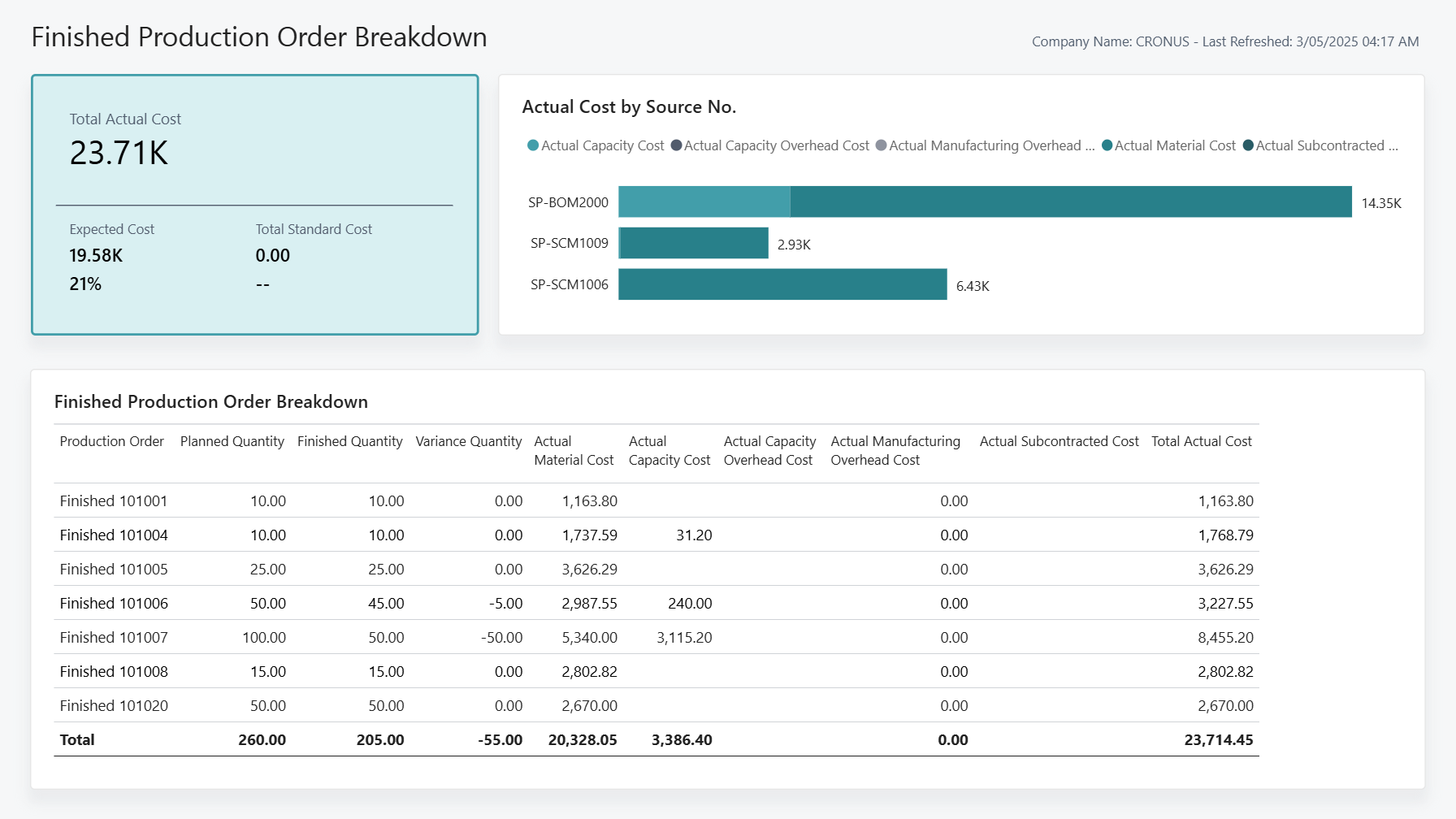
Manufacturing Analysis and Performance Control
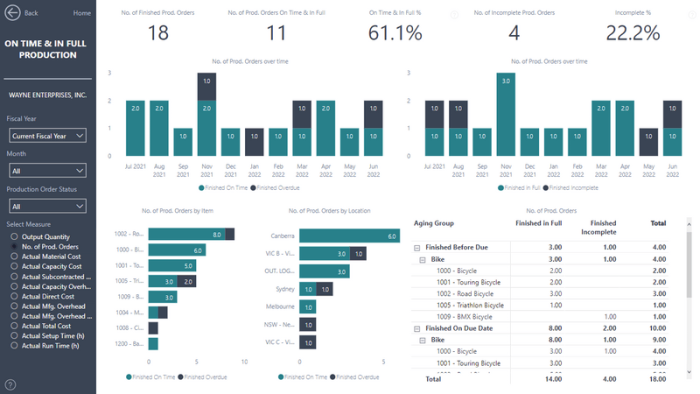
Manufacturing Analysis provides detailed visibility into production performance, enabling organisations to compare what was planned against what actually occurred on the shop floor. By analysing materials, time and output, manufacturers can ensure processes are operating as intended and identify areas for improvement.
Material usage analysis compares actual consumption against production bill of materials (BOM) expectations, helping to identify variances, reduce waste and improve costing accuracy. Routing analysis evaluates planned versus actual setup and run times, providing insight into operational efficiency and highlighting opportunities to optimise production processes.
By-product analysis tracks expected versus actual output, improving visibility of secondary materials and supporting better utilisation, traceability and recovery of value from production activities.
Together, these insights ensure alignment between defined production standards and real-world execution, improving accuracy across component usage, production timing and costing. The result is stronger operational control, more reliable reporting and better-informed decision-making across manufacturing operations.