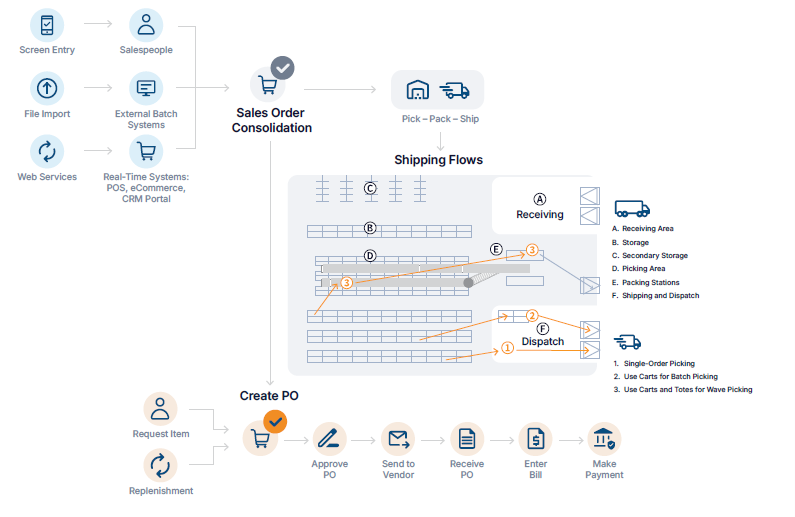
Contents
Smarter Manufacturing with MYOB Acumatica: From Planning to Production
For growing manufacturers, operational complexity rarely increases in neat, predictable steps.
More products mean more bills of material, routings and revisions. More orders place greater pressure on materials planning and production capacity. Inventory becomes harder to balance. Shop floor activity needs to be captured accurately. And finance teams still need to understand what all of this means for costs, margins and cash flow.
When these processes are spread across accounting software, spreadsheets and disconnected applications, the challenge isn't simply administration. It becomes increasingly difficult to see what is happening across the business and make informed decisions quickly.
MYOB Acumatica brings product definition, planning, production, inventory, warehouse management, sales and financial processes together within a connected cloud ERP platform.
Support Different Manufacturing Models
Manufacturers don't all operate in the same way.
A business producing standard products for stock has very different planning requirements from a manufacturer building customised equipment against individual customer orders.
MYOB Acumatica can support a range of manufacturing environments, including:
- Make-to-stock.
- Make-to-order.
- Batch manufacturing.
- Configure-to-order.
- Engineer-to-order.
Rather than treating manufacturing as an isolated function, MYOB Acumatica connects production with the wider supply chain and financial processes that support it.
Define Products Before They Reach Production
Effective manufacturing starts well before an order reaches the shop floor.
MYOB Acumatica provides tools for defining and managing products through bills of material (BOMs), routings, manufacturing estimates and rules-based product configuration.
Product definition capabilities can include:
- Bill of material creation and management.
- Production routings.
- Manufacturing estimates.
- Rules-based product configuration.
- Engineering change control.
- CAD and PLM integration.
Bringing product definition and production together can help engineering and manufacturing teams remain aligned as products, specifications and revisions change.
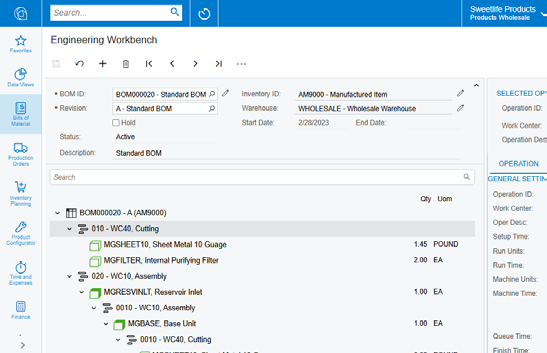
The objective is to establish an accurate product and production structure before materials, labour and capacity are committed to manufacturing.
Plan Materials and Production Capacity Together
Knowing what needs to be manufactured is only part of the challenge. Manufacturers also need to understand whether the materials, people, machines and capacity are available to deliver it.
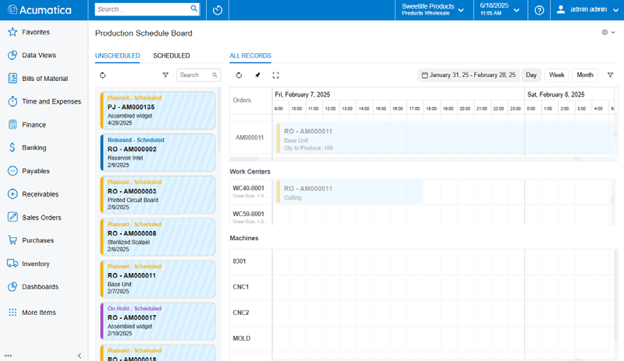
MYOB Acumatica combines time-phased material planning with finite capacity scheduling to help manufacturers identify material requirements and production constraints.
Planning can connect demand with:
- Material requirements.
- Inventory availability.
- Purchasing and replenishment.
- Work centres and machines.
- Labour and production capacity.
- Production schedules.
By bringing these elements together, manufacturers can make more informed purchasing and scheduling decisions while reducing unnecessary work in progress, shortages and excess inventory.
Gain Greater Visibility Across the Shop Floor
Once production begins, timely and accurate information becomes critical.
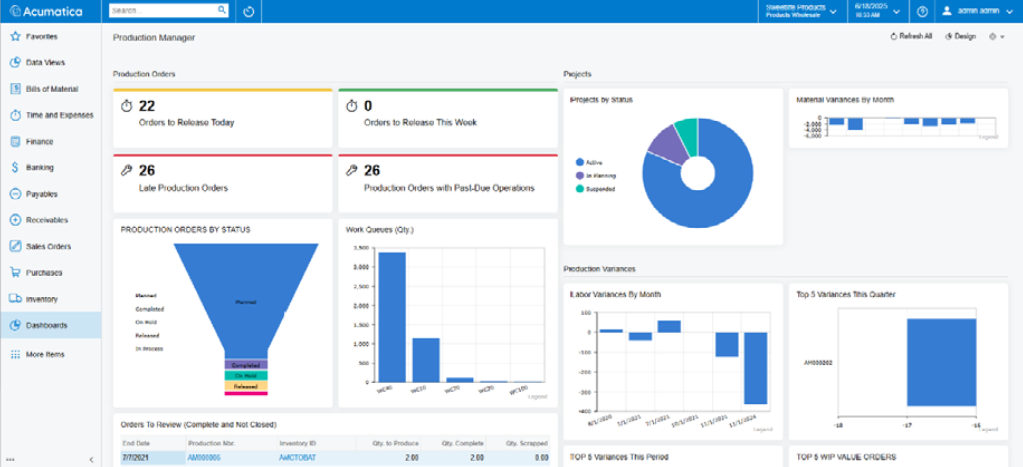
MYOB Acumatica Production Management provides visibility into work in progress, material consumption and labour, with mobile and barcode-enabled shop floor data collection helping capture transactions closer to where they occur.
Manufacturers can compare standard and actual costs and quantities, investigate production variances and identify areas where operational performance may be affecting margins or throughput.
This provides management with a much clearer picture of what is actually happening in production rather than relying on information that is entered or reconciled after the event.
Connect Inventory Directly to Manufacturing
For manufacturers, inventory isn't simply a warehouse function. Raw materials, components, subassemblies and finished goods are all directly connected to production performance.
MYOB Acumatica provides real-time inventory visibility alongside replenishment and material planning capabilities designed to help align supply with production demand.
Lot and serial number tracking supports traceability, while kitting, disassembly and matrix inventory provide additional flexibility for businesses managing more complex product ranges.
These capabilities continue beyond manufacturing into purchasing, order fulfilment and warehouse execution. You can explore this in more detail in our article, From Order to Fulfilment: How MYOB Acumatica Connects Sales, Inventory and Warehouse Operations.
Connect Customer Demand to Production
One of the advantages of an integrated ERP platform is removing unnecessary boundaries between sales and manufacturing.
In make-to-order and job shop environments, MYOB Acumatica can create production orders directly from sales orders. Purchasing for outside processes can also form part of the workflow, while rules-based product configuration can be launched during sales order entry for customised products.
That creates a much more connected process from customer requirement through to production and fulfilment.
Customer Demand → Sales Order → Product Definition → Material Planning → Production → Inventory → Fulfilment
Extend the Process into the Warehouse
Manufacturing doesn't end when an item comes off the production line.
Materials need to be received and moved into production, components need to be issued, finished goods need to be received back into inventory and customer orders ultimately need to be picked, packed and shipped.
MYOB Acumatica's warehouse management capabilities extend the process with mobile access, barcode scanning and guided workflows for activities including receiving, issuing, transferring, picking, packing and shipping.
Rather than treating the warehouse as a separate system, manufacturing, inventory and fulfilment can form part of the same operational process.
Bring Manufacturing and Finance Together
Every production decision ultimately has a financial consequence.
Materials are consumed. Labour and machine time are incurred. Work in progress accumulates. Finished goods are produced. Variances emerge between expected and actual costs.
MYOB Acumatica connects manufacturing transactions with financial management, allowing operational activity to flow through to accounting, reporting, profitability analysis, cash management and budgeting.
For organisations operating across multiple entities or markets, the wider platform can also support intercompany transactions, multi-company consolidation and multicurrency management.
The value isn't simply having manufacturing and finance in the same system. It is being able to understand the financial consequence of what is happening operationally.
Create One Connected Manufacturing Process
The real opportunity with manufacturing ERP isn't any single feature.
It is the ability to connect processes that are frequently managed separately: customer demand, forecasting, product definition, material requirements, purchasing, scheduling, production, inventory, warehousing and finance.
A connected manufacturing workflow can instead look like:
Demand → Plan → Purchase → Produce → Record → Store → Fulfil → Invoice → Analyse
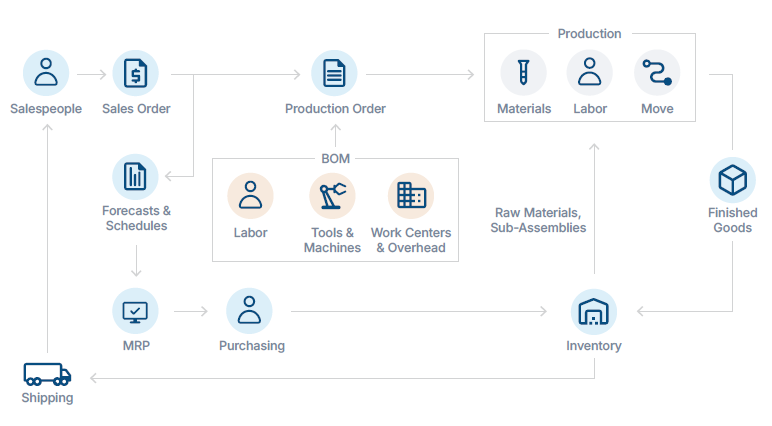
Each stage creates information required by the next. When those processes operate within the same ERP environment, manufacturers can reduce manual intervention, improve visibility and establish more consistent processes as the business grows.
More Than Production Management
This is why we don't see manufacturing ERP as simply a system for creating production orders and recording what happens on the shop floor.
The bigger question is how effectively a manufacturer can connect customer demand with product definition, materials, purchasing, capacity, production, inventory, fulfilment and finance.
MYOB Acumatica provides a cloud ERP platform through which those processes can operate together, giving manufacturers greater visibility across both operational and financial performance.
For a growing manufacturer, the objective isn't simply to produce more. It is to build an operational platform capable of supporting greater complexity as the business grows.
How Cloud Factory Can Help
Cloud Factory helps organisations evaluate, implement and optimise MYOB Acumatica across finance, manufacturing, sales, purchasing, inventory, distribution and warehouse management.
Rather than looking at individual ERP functions in isolation, we work with manufacturers to understand the complete operational process and determine how MYOB Acumatica can be configured to support it.
If you're looking to replace entry-level accounting software, modernise an ageing ERP system or better connect manufacturing with the rest of your business, talk to Cloud Factory about whether MYOB Acumatica is the right fit for your requirements.